Black dots were inexplicably appearing in a woman’s kitchen, which alarmed her.
The woman wondered why she still had blackheads in her kitchen after asking the internet community. He couldn’t believe it might be “spider droppings.” “Does anyone have any idea what these points might be?” she asked on a Facebook group.
“They first appeared on the kitchen tiles, then on top of the PC we keep in the kitchen this morning.”
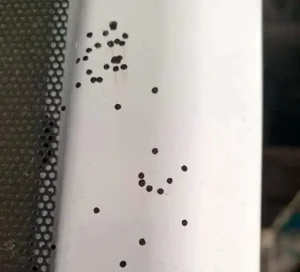
“Look over it and you will probably find a canvas/spider,” someone wrote to him.
“Spiders” do not leave solid excrement; instead, their excrement is thick and liquid, and resembles ink stains, which commonly appear on walls and surfaces, according to the Pest Guidance website. In most circumstances, dark splashes or droplets are to be expected.
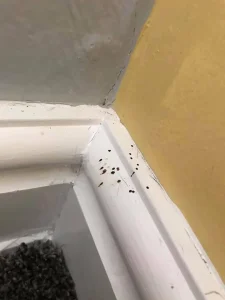
“These droppings contain a mixture of food and other residual components that the spider’s body releases.”
Many people’s greatest dread is spiders. Spiders cause more consternation than mice, birds, flies, cockroaches, or other public health concerns.
Most people, illogically, believe that spiders will attack without warning, plunging their venomous fangs into any adult or child in close vicinity and that the subsequent spider bite will be painful and lethal.
Knowledgeable PMPs are unable to persuade some individuals that mice, flies, and a variety of other indoor pests pose larger harm to human health than spiders, owing to food contamination.
Some entomologists, however, have questioned the health benefits of spider droppings…
Usually when inspecting the filth in the bottom of a container containing a “pet” spider-like a black widow spider.
It’s only a matter of time before the area beneath the “pet” spider resembles the pavement beneath a pesky resident colony of pigeons (which we know is a cause for concern). So, is spider poop safe?
How harmful is it if one of the common spider species found near ceilings indoors defecates on food, a food preparation table, pillows or towels, infant pacifiers or toys, or anything else that might come into contact with a person’s mouth? How deadly are spiders that live inside?
Do Spider Droppings Contain Pathogens?
Several common human pathogens, including Staphylococcus spp., Streptococcus spp., Enterococcus spp., Salmonella spp., and E. coli, have been recovered from filth flies (White 2006, Butler et al. 2010). Pathogenic bacteria have also been discovered in the excrement or droppings of flies, according to studies (Kobayashi et al. 1999).
The microbiological residents of spiders and their droppings, on the other hand, have received less attention. What happens when a spider feeds on filth flies, specifically?
Is it possible for pathogenic bacteria to slip through the spider and land somewhere below it? Is there a public health rationale to avoid spiders indoors, other than certain people’s fear of them?
To answer these problems, Melissa Gaver-Wainwright, an entomology graduate student at Washington State University, undertook some early study.
A fecal sample was swabbed from a sterilized container and dipped in a growing medium to increase the number of bacteria in the sample to assess the possibility for disease transfer from black widow spider (Latrodectus Hesperus) waste material.
She then used universal bacterial primers to amplify a conserved portion of the 16S rRNA gene in order to identify microbes associated with the feces. The spider feces had no germs that could be identified.
The outcomes were perplexing. According to several research, some spiders’ venom (and blood) include antibacterial capabilities, which could explain the lack of microorganisms observed. E. coli, Staphylococcus spp., Enterococcus spp., Pseudomonas spp., and other bacteria have been demonstrated to be vulnerable to these broad-spectrum antibacterial peptides.
Many issues remain, such as whether other species of web-building spiders would have bacteria-free droppings as well, or whether various molecular approaches would yield different results.
Controlling filth flies may be more important than controlling spiders when it comes to protecting one’s health. Spider droppings, on the other hand, are not acceptable indoors.